

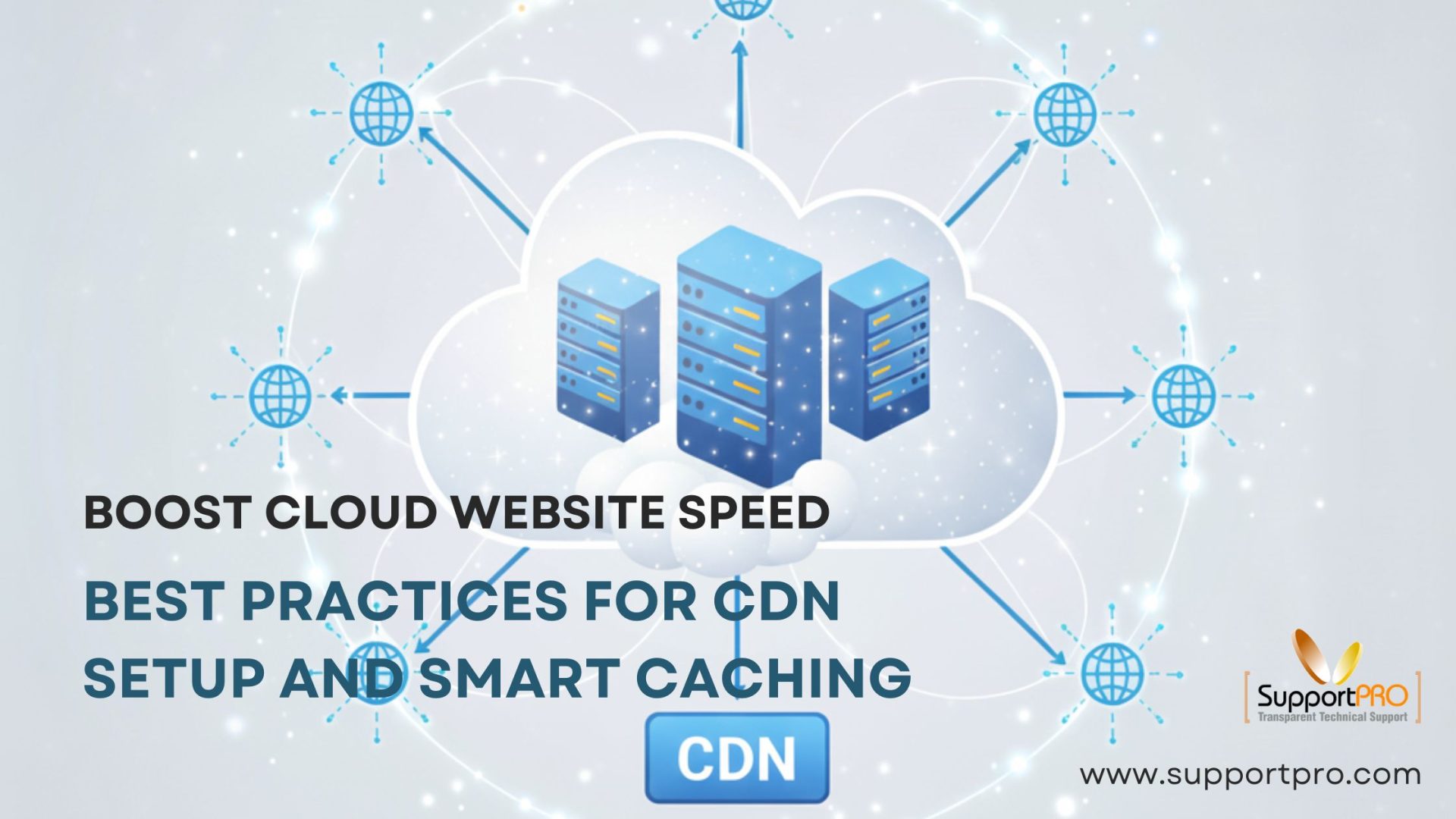
While using the web in today’s life, the users expect their pages to load quickly and specifically on mobile & across the globe all over the world. The websites that are hosted in the cloud, and combined with CDN, with smart caching strategies is the most effective path to reduce the latency issues, to reduce the server load and that helps to deliver a faster user experience.
What is a CDN, and the reason & benefits to combine it with caching?
A CDN [Content Delivery Network] is also referred as Edge servers or points of presence” (PoPs) , it is system in which servers are distributed globally and those servers store the cached copies of websites content like images , videos to deliver the data to users from the server that is closest to them. This way it helps to receive the data fast from the nearest location server. As this reduces the physical network distance and minimizes the latency.
But the CDN itself is just a delivery mechanism, the actual benefit is when we cache the web data and content using CDN caching on CDN edges level. So In this, the actual origin(Cloud) server does not serve every request, so it reduces the origin server load and bandwidth usage.
Users fetch static or semi-static data from a closer node, it improves response of the content.
The users are far away from the origin server, they gain better performance and consistency across regions.
CDN + caching = content stored close to users + fewer trips to the origin
Types & layers of caching
- Edge (CDN) caching
This caching is done by CDN servers. These edge nodes store the content fetched from the origin server and serve them to subsequent users.
In some cases, the file has not yet been cached on the edge server, this is called a “Cache MISS” , where the data is not readily available on the edge server to be sent back to the client. While, when the edge server already has the requested data, that’s a “Cache HIT”
- Origin caching
In this caching logic, closer to backend or origin server. It also involves the reverse proxies, eg. Vanish. Or application level cache that reduce how often the backupend must fetch the data.
- Browser (client-side) caching
In this, the user’s browser keeps the copies of data (e.g. JS, CSS images) it will fasten the repeated visits, Settings are done in order to instruct the browser how long it should keep the resources using HTTP headers.
Implementing CDN + caching for cloud hosted website
- First you need to choose a CDN provider.
There are many CDN provider available in market like Cloudflare, AWS CloudFront, Akamai etc. Each of them providers different features, pricing and configuration sets.
- You need to point your domain to the CDN / configure DNS
It requires to set up a CNAME or modify DNS so traffic routes through the CDN layer.
- Set up origin settings / bucket / server
The origin (cloud server, S3 bucket, etc.) remains the source . You need to ensure it sends proper cache headers and is reachable by CDN.
- Define caching rules / headers
On origin server, need to configure Cache-Control, ETag, and other headers. In the CDN dashboard, define path-based TTLs or override caching behavior for certain paths/extensions as per the requirements.
- Version static data / implement cache busting
Use build-in tools to append content hashes to file names whenever they change, so clients always fetch latest versions after updates.
- Purge or invalidate cache on deployment
You need to automate purge via CDN API when you deploy new content, so stale files are removed immediately.
- Test & monitor
You can use the testing tools like PageSpeed Insights, webpage test from multiple geographies,
check response headers like X-Cache, CF-Cache-Status, or Via to see whether requests are served from cache. Also monitor cache hit ratio metrics. If the content are dynamic then the hit ratio can be ignored.
Using below steps, you can impletment the CDN and caching strategy using AWS services like EC2 , S3, CloudFront.
- Login to your AWS account.
- For static website, create S3 bucket. Uncheck “Block all public access” to allow public access (needed for a public website) as per the requirements.
- Upload your website static files (HTML, CSS, JS, images).Go to the “Properties” tab of your bucket and click on “Static website hosting” and enable it., specify the index document eg. index.html.
- Now Setup your EC2 instance for dynamic content,
- SSH into your EC2 instance – Install a web server (e.g., Apache or Nginx) as per the website requirements.
- Configure the security group to allow it port http(80) & https (443)
- Create a CloudFront Distribution and set the origin domain to your S3 bucket or your EC2 instance public domain as needed.Also you can set the redirection from http to https while CloudFront distribution creation, In the viewer protocol policy, choose “Redirect HTTP to HTTPS” to make the secure delivery
- Setup caching settings, for testing purpose you can keep the default settings.
- Wait for deployment, as CloudFront distributions can take a while to deploy
- Then finally you need to update the DNS records.
- If you have a domain to any third party provider , go to your DNS provider and create a CNAME record that will point to your CloudFront distribution domain.you should see the CNAME after creation of CloudFront distribution
- You need to set Cache-Control Headers for HTTP headers in your S3 bucket or from your EC2 application to control the caching behavior. For example, you can set longer cache for images, and a shorter one for HTML files.
- You need to use the Invalidations, those will refresh the cache as soon the changes are done to content.
- You can use tools like AWS CLI or SDKs to automate the parts of this process
Every user expects websites to load instantly. No matter where they are or what device they’re on. Using CDN and caching for cloud-hosted websites is one of the most practical ways to deliver that speed, reduce latency, and keep your infrastructure running efficiently.This blog explains everything you need to optimise performance, from CDN selection to cache rules, invalidations, and AWS-based implementations. If you’re looking for expert support to fine-tune your cloud setup, troubleshoot performance challenges, or fully manage your CDN configuration, our team is ready to partner with you. Reach out anytime—we’re here to help you accelerate your website with confidence.
Facing issues?
Our technical support
engineers can solve it.


