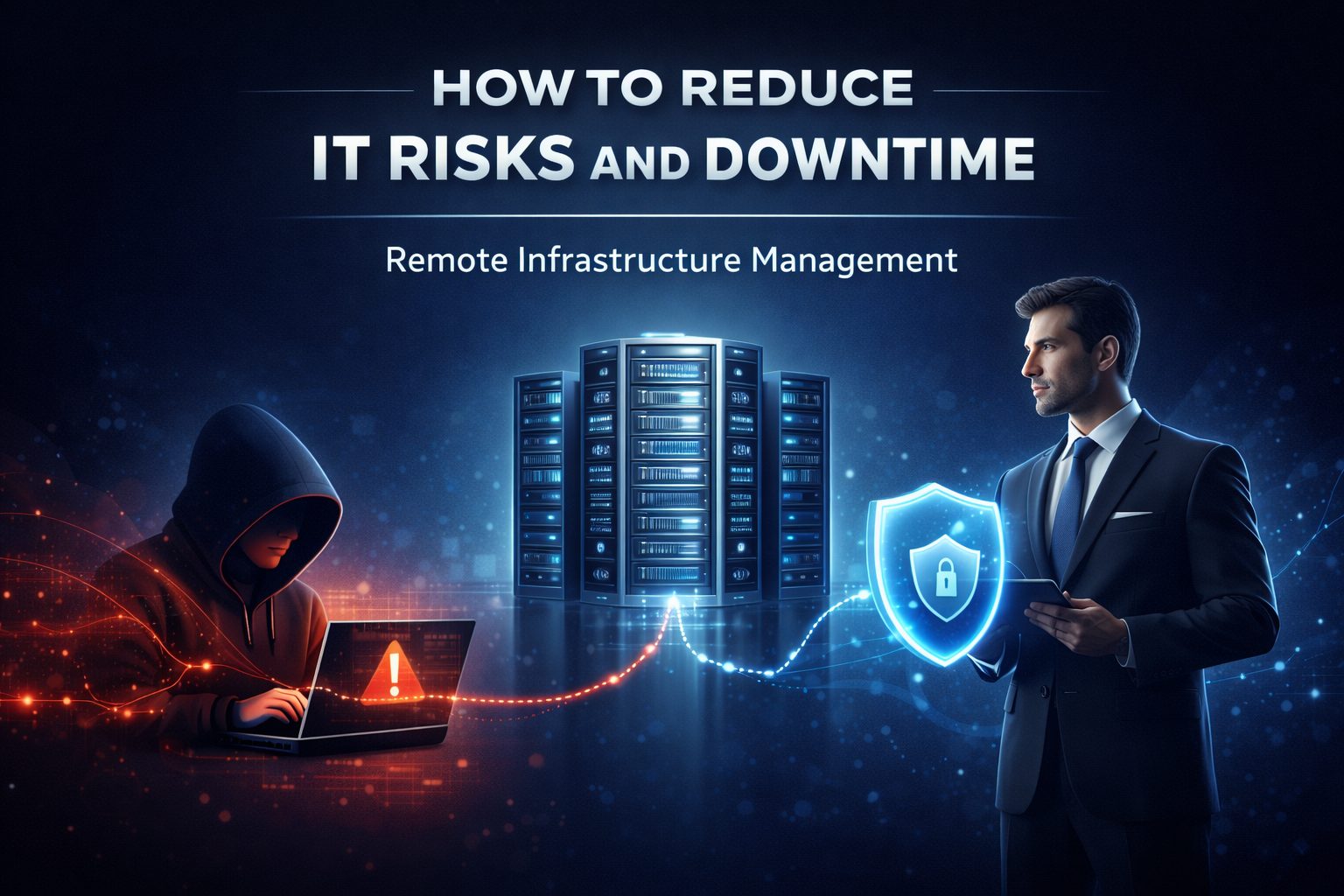
IT downtime directly affects revenue, productivity, and customer trust. As infrastructure environments grow more complex, traditional IT management approaches struggle to maintain stability and security. Remote Infrastructure Management, or RIM, helps businesses reduce IT risks and downtime by providing continuous monitoring, proactive maintenance, and faster incident response.
What Causes IT Risks and Downtime ?
A large proportion of infrastructure failures stem from operational gaps that could be detected or mitigated earlier, alongside unavoidable external or platform level events.
1. Hardware failures
Aging or overloaded hardware often exhibits early warning indicators (SMART errors, I/O latency, thermal alerts) that go unnoticed without proper monitoring. Without early detection, minor performance issues escalate into outages that disrupt business operations.
2. Patch delays
Systems that are not updated regularly remain exposed to known vulnerabilities and bugs. Unmanaged or excessive patch delays increase exposure to known vulnerabilities, while untested patching can introduce instability. A controlled patching strategy is required.
3. Misconfigurations
Incorrect or inconsistent system settings can cause access issues, performance degradation, and service failures. These errors often go unnoticed in environments without centralized control.
4. Limited visibility
Without real-time monitoring, infrastructure teams lack insight into system health and usage trends. This prevents early identification of risks and delays corrective action.
5. After hours gaps
Issues that occur outside business hours often remain unresolved until teams are available. This extends downtime and increases the impact on users and customers.
Why Traditional Infrastructure Management Is Ineffective ?
Traditional infrastructure management models often rely on limited staffing, manual processes, and business hour coverage, which struggle to scale with always on and hybrid environments. It struggles to support modern businesses that rely on continuous availability, rapid scaling, and strong security controls.
- Reactive Handling : Issues are addressed only after systems fail or users report problems. This delay allows minor faults to escalate into outages, increasing downtime, recovery effort, and business disruption.
- Limited Coverage : Most in-house IT teams cannot provide continuous monitoring due to staffing and cost limitations. Gaps in coverage mean failures and security incidents can go unnoticed for hours, increasing operational risk.
- Individual Dependency : In some environments, undocumented knowledge or limited cross-training can create dependency on specific engineers, slowing incident resolution when they are unavailable.When key personnel are unavailable, incident resolution slows and risk exposure increases.
- High Operational Overhead : Scaling internal teams, tools, and monitoring capabilities increases fixed costs. This reduces flexibility and makes it difficult to support growing or changing infrastructure efficiently.
- Inconsistent Security Controls : Patching, access controls, and security policies are applied unevenly across systems. These inconsistencies create exploitable gaps, increase compliance risk, and weaken overall infrastructure security.
What Is Remote Infrastructure Management (RIM) ?
Remote Infrastructure Management (RIM)is a centralized approach to managing IT infrastructure using remote teams, tools, and standardized processes.
- Continuous monitoring : Infrastructure components are monitored in real time to track performance, availability, and resource usage. This provides constant visibility into system health.
- Proactive maintenance : Maintenance tasks such as patching, updates, and configuration checks are performed on a defined schedule. This prevents issues before they affect operations.
- Incident response : Alerts trigger immediate action from dedicated teams trained to resolve infrastructure issues quickly. This reduces resolution time and service impact.
- Security enforcement : RIM teams enforce agreed baseline security configurations (OS hardening, patch levels, access controls) within the scope defined by the customer’s security policies. This improves overall risk control.
- Performance optimization : System performance is continuously evaluated to ensure infrastructure runs efficiently and reliably under changing workloads.
Scope of Remote Infrastructure Management
Remote Infrastructure Management covers critical infrastructure components across on-premises, cloud, and hybrid environments.
- Server management : Physical and virtual servers are monitored, maintained, and optimized to ensure availability and performance. This includes operating system health and resource usage.
- Network oversight : Network devices are monitored for availability, interface health, and performance indicators, enabling faster detection and coordinated resolution of connectivity issues.
- Cloud visibility : Cloud and hybrid infrastructure resources are tracked centrally to maintain performance, cost control, and operational consistency.
- Backup readiness : Backup jobs and retention are monitored, and periodic restore tests can be performed as part of an agreed recovery validation process. This reduces risk during failures or incidents.
- Security patching : Routine and emergency patches are applied consistently across systems. This reduces exposure to known vulnerabilities.
- Capacity planning : Usage trends are analyzed to identify future capacity requirements. This helps prevent performance degradation caused by resource shortages.
How RIM Reduces IT Risks and Downtime ?
Remote Infrastructure Management reduces risk and downtime through prevention, speed, and operational consistency.
- 24/7 monitoring : Infrastructure components are monitored continuously for performance, availability, and resource usage. Early indicators such as disk saturation or abnormal traffic are detected before they cause outages.
- Instant alerts : Automated alerts notify teams immediately when thresholds are breached or abnormal behavior occurs. This ensures issues are identified as soon as they arise.
- Rapid response : Dedicated remote teams respond to incidents without delay, including outside business hours. Faster response reduces resolution time and limits business impact.
- Scheduled patching : Operating systems and applications are updated on a defined schedule to address known vulnerabilities. Consistent patching improves stability and security.
- Standard controls : Predefined but robust configurations are enforced across environments to prevent configuration drift. This reduces errors that commonly lead to outages or security gaps.
- Predictive insights : Trend analysis and historical data help identify early warning signs such as capacity exhaustion, recurring faults, or abnormal behavior.
- Automated remediation : Where approved, predefined automation can be used to remediate common, low-risk issues, reducing response time while preserving change control. Automation reduces human error and improves system availability.
Outcome
Together, these practices reduce infrastructure risk by improving visibility, enforcing consistency, and accelerating response. Downtime is minimized by preventing failures rather than reacting after a disruption occurs.
Industry Trends Driving the Shift to RIM
Current industry changes are pushing businesses toward Remote Infrastructure Management.
Hybrid environments
Conclusion
Modern infrastructure spans on-premises systems, cloud platforms, and remote locations. Managing this complexity requires centralized visibility and control.
- Talent shortages : Skilled infrastructure professionals are limited and expensive to retain. This makes it difficult for businesses to maintain in-house coverage.
- Always on demand : Customers and employees expect systems to be available at all times. Downtime is less tolerated in digital-first operations.
- Rising threats : Cybersecurity risks and compliance requirements continue to increase. This raises the cost of weak or inconsistent infrastructure management.
- Cost pressure : Organizations are under pressure to reduce operational IT spending while maintaining reliability. RIM offers a scalable alternative to expanding internal teams.
When to Adopt Remote Infrastructure Management ?
Remote Infrastructure Management becomes essential when businesses face increasing operational strain.
- Frequent outages : Repeated system failures disrupt operations and reduce productivity. RIM helps stabilize infrastructure and prevent recurrence.
- Infrastructure growth : Expanding systems, users, or locations increase management complexity. Centralized control simplifies operations.
- Resource constraints : Limited internal IT staff struggle to provide continuous coverage. RIM fills these gaps without increasing headcount.
- Security pressure : Rising compliance and security demands require consistent monitoring and enforcement. RIM improves control and audit readiness.
Reducing IT risks and downtime requires continuous visibility, proactive maintenance, and fast response. Remote Infrastructure Management provides a structured and scalable way to maintain infrastructure reliability without increasing internal overhead.
Providers like SupportPro help businesses implement Remote Infrastructure Management to stabilize operations, reduce risk, and ensure consistent system performance.
Facing issues?
Our technical support
engineers can solve it.