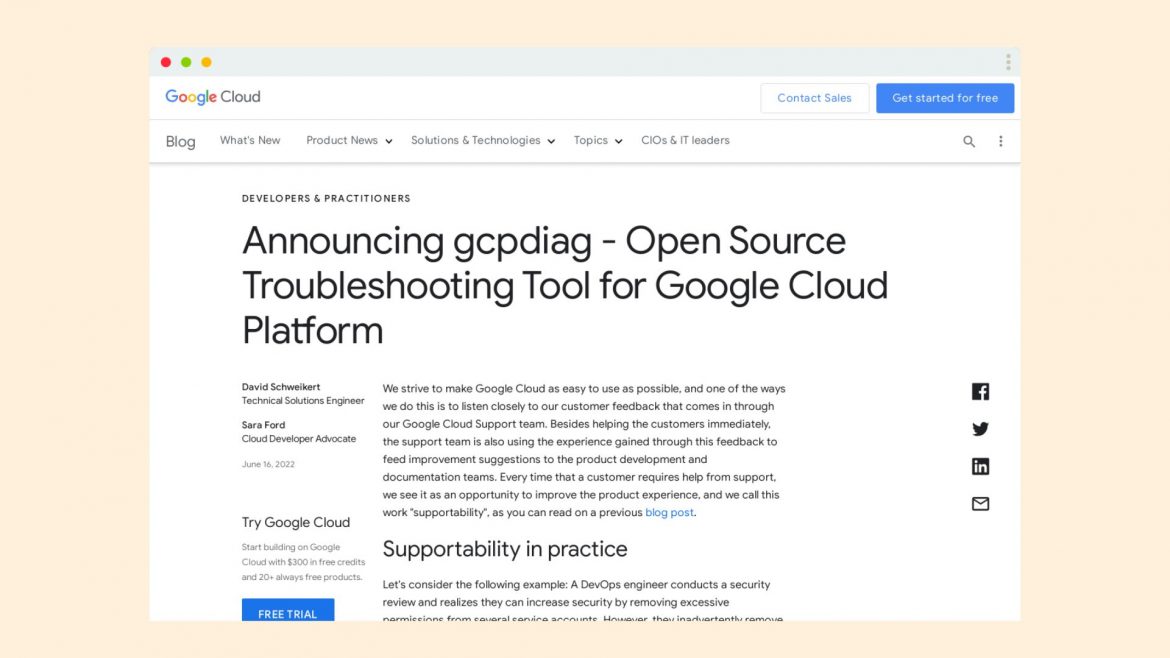
A command-line diagnostics tool for GCP users is called gcpdiag. It identifies and assists in resolving frequent problems in Google Cloud Platform projects. Based on the Google Cloud Support team’s troubleshooting expertise, it is used to test applications against a variety of best practices and common errors. Contributions are welcome for gcpdiag, an open-source programm! Please be aware that this is a community effort rather than a Google product that is officially supported. What are the Pre-requisites for gcpdiag? The following are necessary for gcpdiag to function properly: 1. Permissions The …
MariaDB is considered as the fork(replica) of MySQL database. It was developed by the same developer as that of MySQL except for the fact MariaDB offers many more additional functionalities to the MySQL engine. PostgreSQL is an alternative to MySQL working on ORDBMS (Object-Relational Database Management System). As a database server, its primary function is to store data, securely and supporting best practices, and retrieve it later, as requested by other software applications, be it those on the same computer or those running on another computer across a network. The …
Phusion Passenger is a free web server and application server with support for Ruby, Python and Node.js. It is designed to integrate into the Apache HTTP Server or the Nginx web server, but also has a mode for running standalone without an external web server. Phusion Passenger supports Unix-like operating systems, and is available as a gem package, as a tarball, or as native Linux packages. Passenger and “Rails server” The Ruby on Rails framework provides a built-in server tool, which can be accessed with the ‘rails server‘ command. The …
Ansible is a multipurpose automation tool used for workflow automation and configuration management. With the Infrastructure as Code approach, teams define and manage system configurations by specifying the packages, versions, and services that must run on a system. This method ensures consistent environments and simplifies infrastructure management.Automating workflows could involve anything from deploying software to setting up cloud infrastructure. Ansible is a Python application that uses SSH to run commands on many devices. Ansible is agentless, which makes learning how to use it much simpler. SSH access and Python installed …
AWS Organizations help you to centrally manage, grow and scale your AWS resources. Using AWS organization allows programmatically creating new AWS accounts, allocating resources, group accounts to organize your workflows, and simplifying billing by using a single payment method for all of your accounts. AWS Organization Benefits AWS Organization Use Cases 1. Creation of AWS accounts and categorize workloads using groups: Automate the creation of new AWS accounts, when you need to quickly launch a new work environment, auditing and touchless infrastructure deployments. For example, Easy to create separate groups …
Docker Compose is an application definition and execution tool for multi-container docker applications. Using Docker Compose, you can connect all the isolated containers as a single service. The containers are still segregated, but they can interact with one another. A YAML file makes it possible to configure the services of your application. Then, with one command, you create and start all services from your configuration. With Docker Compose, you get the benefits of single host deployment, great security, and ease of set up & configuration which leads to really high …
In Linux, everything running on the system is a process. Whether it’s a system service, background daemon, or user application, each runs in its own virtual address space. Since Linux is a multitasking operating system, multiple processes run simultaneously. Understanding how to monitor and manage these processes is a core skill for Linux administrators. This guide explains: What Is a Process in Linux? A process is a running instance of a program. When you execute a command, Linux: Every active task in Linux – including system services operates as a …
The RPM Package Manager (RPM) is a powerful command-line driven package management system capable of installing, uninstalling, verifying, querying, and updating computer software packages. Each software package consists of an archive of files along with information about the package like its version, a description, and the like. There is also a library API, permitting advanced developers to manage such transactions from programming languages such as C or Python. Yum is an automatic updater and package installer/remover for rpm systems. It automatically computes dependencies and figures out what things should occur …
Getting Started with Ansible AWX: Complete Setup and Configuration Guide
Ansible is a popular automation tool based on Infrastructure as Code (IaC), used for provisioning infrastructure, managing virtual machines, and deploying applications across environments. It simplifies tasks such as configuration management, cloud provisioning, and service deployment. Ansible AWX is the open-source, community-driven version of Ansible Tower. It serves as a web-based interface and automation hub that makes managing Ansible workflows easier. AWX is often used in lab environments, proof-of-concept setups, and testing scenarios, and it forms the foundation for the enterprise-grade Ansible Tower. Why Use Ansible AWX? Ansible AWX enhances …
AWS Fargate is a computational engine for Amazon Elastic Container Service (ECS) that allows you to execute containers without having to provide, configure & scale clusters of VMs.Now let’s take a little deeper and see how this AWS Fargate actually operates. From the image below, you can see as a first step you built a continuous image in this container.