

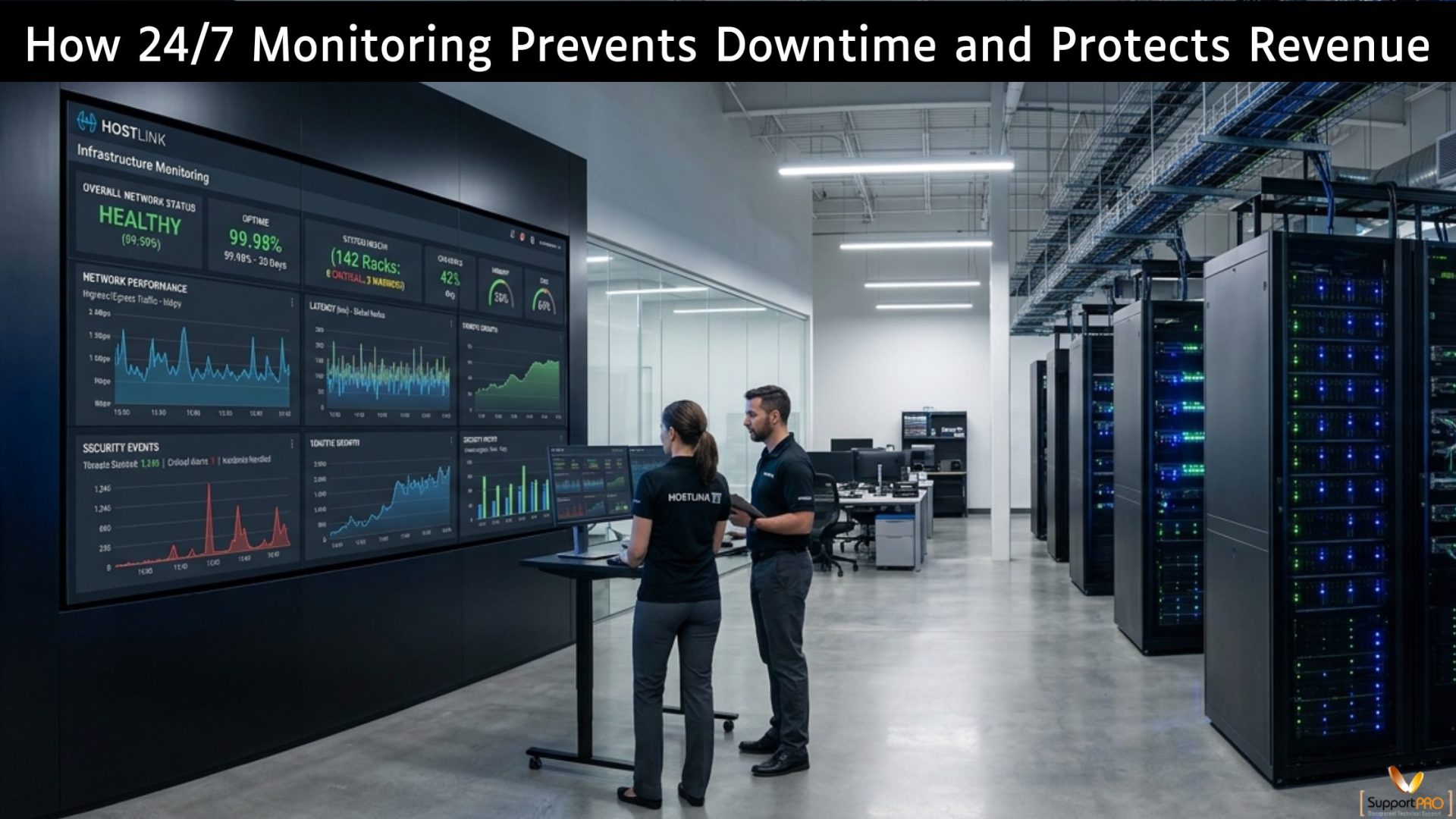
In the web hosting industry, uptime isn’t just about technical metrics; it seriously affects customer satisfaction, how long they stick around, and business growth. Hosted sites need to run non-stop, so any brief outage can spark complaints, frustrate users, and cost companies revenue and clients. With more competitors popping up all the time, hosting firms must prevent those unplanned hiccups at all costs.
Downtime usually catches us off guard. Server spikes, hardware crashes, network slowdowns, app glitches, and security hazards often start small but turn major. If we don’t keep an eye on things, these problems might only get noticed when customers are affected, and operations slow down.
That’s why non-stop monitoring matters. Instead of waiting for customer complaints, real-time oversight lets hosting services catch and fix issues early. Watching servers, networks, apps, and security continuously means less downtime, happier customers, and saved revenue. Here, we will explore why continuous monitoring matters, how it prevents downtime, and how it directly protects business revenue.
Downtime Real Cost
Organizations tend to undervalue the real cost of downtime due to their tendency to estimate the loss of revenue from downtime, which comes out very clearly. However, it is more than just that. Downtime leads companies to suffer:
1. Revenue Loss
Downtime for hosting and managed service providers results in SLA violations, customer loss, and increased support calls. It also means losing that much-needed recurring revenue. Even a short outage can affect many clients and erode trust in the reliability of your services.
2. Productivity Loss
Failure within the system results in staff being unable to use their tools, a lack of communication, and an overall operational slowdown. This cost is usually hidden and affects several departments at once.
3. Customer Dissatisfaction
In today’s market, customers demand constant accessibility and flawless service delivery. Disruptions in the service delivery process result in customer distrust and increased churn. Re-establishing customer confidence is costly.
4. Brand Damage
Downtime creates a problem of perception. No one will remember long periods of uptime, but everyone remembers downtime. A simple outage can cause serious harm to your reputation, beyond the problem itself.
5. Emergency Recovery Costs
In many cases, unexpected system failures lead to increased costs due to emergency troubleshooting, overtime, and rushed vendor support. Emergency work always costs more than prevention.
Why Traditional Break-Fix Support No Longer Works
Many hosting companies used to use reactive IT support for decades:
- An error occurs.
- A user reports the error.
- A ticket is logged.
- An engineer investigates the problem.
- The error is fixed.
This approach might work when technologies are less complicated. Nowadays, business infrastructure is significantly more complicated. Modern companies work in:
- Hybrid clouds
- Several servers
- Distributed applications
- Databases
- Application programming interfaces
- Remote employees
- Third-party integrations
- Global customer bases
An error in one part of your technology infrastructure could cause other errors. Responding to a user’s problem report is no longer a valid option. By the time you learn about an error, the problem has already occurred.
What Is 24/7 Infrastructure Monitoring?
24/7 infrastructure monitoring is the continuous monitoring of your infrastructure to ensure the proper performance and safety of your vital systems throughout the day. It involves monitoring various elements within your environment, such as the health of your servers in terms of CPU usage, memory, disk space, uptime, and hardware. Other factors that you can monitor include your bandwidth, latency, network connectivity, and packet loss. Other aspects include the availability of applications and the monitoring of databases by measuring query speed, storage growth, and response times. Security events can be detected through monitoring to find out any abnormal activity and verify backup systems. The primary goal of 24/7 monitoring is simple: to identify abnormalities early and resolve them proactively, before they impact users, cause downtime, or disrupt business operations.
How 24/7 Monitoring Prevents Downtime?
1. Detects Problems Before They Become Outages
Most outages do not occur immediately. They develop slowly.
- The disk becomes full.
- Memory usage grows.
- Database performance becomes slow.
- Processes start behaving erratically.
In the absence of monitoring, it would be quite difficult to notice such indications. But with 24/7 monitoring, alarms would immediately go off as soon as limits are exceeded, enabling preemptive action. Such proactiveness is what makes all the difference between a small problem and a big one.
2. Enables Faster Incident Response
When immediate alerts are triggered, there is an immediate response. As opposed to waiting for customers to make complaints, engineers already know:
- What has failed
- Where it has failed
- The urgency with which they should be attending to the problem
This greatly lowers the Mean Time to Detect (MTTD) and Mean Time to Resolve (MTTR) . An immediate reaction reduces downtime, resulting in lower revenue losses.
3. Prevents Small Issues from Escalating
All infrastructure components are interconnected. So,
- Database failure may cause application failure.
- Application failure may cause server failure.
- Server failure may cause client environment failure.
Problems that go undetected worsen and affect more processes. This is why monitoring prevents such a problem from escalating.
4. Improves Security Response
There are many instances where cyber attacks begin with small warning signs, including:
- Abnormal Traffic
- CPU Anomalies
- Login Failures
- File Anomalies
It is only through continuous monitoring that these small signs can be caught before they escalate into major problems. Continuous monitoring serves as a defensive measure before any action is required.
5. Supports Capacity Planning
Downtime occurs when businesses grow faster than their infrastructure.
- There is traffic.
- More demand from customers.
- Applications are bigger.
The monitoring process identifies usage patterns. These help companies ask themselves:
- Are we ready for more capacity?
- What applications are struggling?
- Are there any bottlenecks?
How 24/7 Monitoring Protects Revenue
Many corporate executives consider infrastructure monitoring nothing more than an operational or technical cost. But nowadays, when businesses operate digitally, there are more monitoring functions. The primary task is to ensure revenue stability, customer satisfaction, and no financial losses.
There is hardly any company that operates without technology today. Every business uses a public website, a SaaS solution, an e-commerce site, hosting, or business applications. All of these require proper infrastructure functioning, which affects your ability to generate revenue from operations. Thus, round-the-clock monitoring must be considered as revenue protection rather than a routine IT process. This is how 24/7 monitoring can help you keep your revenue streams flowing.
- It Prevents Lost Sales
Availability is an indispensable element for any business that is based on internet resources. Customers are expected to access websites, applications, and services around the clock. When there are technical difficulties with a system, potential clients may stop shopping and visit other websites.
For e-commerce, software-as-a-service, and other businesses, the availability of online systems can mean millions of dollars lost per day due to downtime. Such continuous monitoring of systems will allow you to avoid such situations, since a system’s availability depends on its resources. Problems with applications, networks, servers, and databases should be resolved to keep your business running. It will not only help you save money but also ensure recurring income sources for further development.
- It Preserves Customer Retention
Trust from customers is probably the greatest asset that an organization can possess. Consumers require consistent access to technology. Service disruptions, delayed application loading, or frequent outages can make consumers question a provider’s ability to deliver quality service.
Reliability is important in retaining customers in competitive markets where consumers have no problem switching to another provider. Continuous monitoring of service availability makes it possible for organizations to identify and solve any potential service interruption before it causes damage. A reliable service improves customer satisfaction and fosters stronger relationships between companies and their clients.
- It Reduces Support Costs
Downtimes put pressure throughout the organization. During downtime, support teams typically receive an influx of tickets, complaints, and escalations. There is an increased burden among the technical teams as well as other internal departments since their activities are affected.
All these actions consume time and cause unnecessary expenses for the business. Monitoring prevents such instances from happening. It enables early detection of problems, making it easier to resolve them before they escalate into complete outages. This helps reduce the number of emergencies the company faces.
- It Protects Service-Level Agreements (SLAs)
Uptime requirements for hosting companies, managed service providers (MSPs), software-as-a-service firms, and enterprises are often contingent on Service-Level Agreements (SLAs). The following can occur when availability requirements are not met:
- Penalties
- Loss of Clients
- SLA Infringements
- Reputational Damage
If there is no ongoing monitoring, companies will not be able to identify deteriorating service quality in time to ensure that their SLAs are fulfilled. 24/7 monitoring ensures companies have real-time insights into their infrastructure and service availability, enabling them to respond instantly to issues. Automated alerting, proactive issue escalation, and rapid response to incidents contribute to minimizing downtime and adherence to SLAs. Maintaining SLAs can help protect client trust.
- It Enables Confident Business Growth
As organizations grow, the complexity of infrastructure needs also grows. So,
- More traffic is generated.
- More applications are used.
- Higher customer demands are expected.
- New capabilities are brought on board.
If there is no visibility into the infrastructure performance, then growth can actually be a liability. The infrastructure that handled regular workloads might now struggle to do so, leading to slower operations or even downtime. Real-time monitoring enables companies to make well-informed infrastructure decisions through trend analysis, bottleneck detection, and resource consumption monitoring.
- It Minimizes Long-Term Financial Risk
The implications of downtime are not limited to revenue losses. Other potential costs might include:
- Costs associated with recovery efforts
- Overtime pay for employees
- Reputational losses
- Compensation for customers
- Fewer sales in the future due to a damaged reputation
Repeated infrastructure failures can negatively affect a company’s market standing over time. Monitoring around the clock will help mitigate these issues through greater stability and reliability. It is usually cheaper to avoid outages than to deal with their aftermath. Many companies find monitoring an investment worth making.
- It Improves Operational Efficiency
As systems are monitored regularly, businesses can become more aware of their infrastructure’s performance on a daily basis. Through monitoring systems, teams can recognize inefficiencies and streamline operations, thus increasing performance. Instead of dealing with problems arising from unanticipated system malfunctions, technical teams can:
- Improve Infrastructure
- Ensure Security
- Consider Upgrading
- Foster Innovation
Industries That Benefit Most from 24/7 Monitoring
- Web Hosting Providers: Web hosting firms must be available round the clock, as their clients expect that websites and applications hosted on their servers will be available at all times.
- Managed Service Providers (MSPs): MSPs are expected to manage and monitor clients’ networks and ensure that services delivered to clients are consistent and reliable.
- SaaS Providers: With SaaS, the availability of the software platform becomes crucial. The more accessible the platform is, the better the service provider’s performance, stability, and trustworthiness.
- E-Commerce Businesses: E-commerce organizations need their websites to be available without interruption since they conduct business through their websites by offering e-commerce facilities.
- Healthcare and Financial Institutions: Healthcare organizations need platforms to run their operations. The availability and security of the IT infrastructure become critical to such enterprises.
- Hybrid Enterprises: In hybrid organizations with infrastructure spanning across clouds and on-premises facilities, monitoring becomes crucial to ensure consistency and performance of the enterprise IT infrastructure.
Why Many Businesses Outsource 24/7 Monitoring
Building an internal monitoring team sounds ideal, but it is expensive. To truly operate 24/7, businesses need:
- Multiple Shifts
- Specialized Engineers
- Advanced Tooling
- Documented Processes
- Escalation Systems
- Ongoing Training
With outsourced monitoring, businesses gain:
- Round-the-Clock Coverage – No gaps, no after-hours blind spots
- Faster Escalation- Dedicated experts respond immediately
- Lower Operational Costs- Access enterprise-grade support without building an internal NOC
- Scalability- Support grows as your business grows
- Specialized Expertise- Experienced engineers handle servers, cloud environments, migrations, and critical incidents
What to Look for in a Monitoring Partner
Your vendor must become part of your team. If you opt to outsource your monitoring needs, you will need to find a partner that can provide:
- True 24/7 monitoring
- Proactive notification management
- Technical expertise
- Server knowledge
- Cloud knowledge
- Security know-how
- Proper reporting
- Good uptimes
The Hidden Risks of Not Having 24/7 Infrastructure Monitoring
Many companies feel secure because all the systems seem to be functioning well- until an unexpected failure occurs. This is because most infrastructure failures are very subtle in their beginnings. For instance, one could note that a server is overheating more than usual, or that the databases are running more slowly due to higher load. However, these indicators cannot be detected without constant monitoring. Companies usually underestimate the risks that accompany non-stop monitoring. Risks include:
- Small Problems Become Major Outages
Major outages usually start as simple technical problems such as high CPU utilization, disk space shortage, unsuccessful backups, or problems in software applications. Without proper monitoring, issues go unnoticed until they lead to major outages. An issue that would have taken mere minutes to fix can take hours to recover from.
- Customers Discover Issues Before Your Team Does
One of the greatest operational risks is knowing about outages from customers. If customers have to report an outage first, it means there’s no visibility and erodes trust in your service’s availability. Organizations that have reactive help lose precious minutes before they can even start the troubleshooting process.
- Slower Response Means Longer Downtime
Without automated alerts and real-time visibility, IT teams spend precious time identifying issues before they can solve them. That delay increases Mean Time to Resolution (MTTR) and directly increases business impact.
- Increased Security Exposure
Not all cybersecurity dangers create an immediate alert. Strange network traffic, illegal entry attempts, and unusual activity could be overlooked without constant supervision, offering cybercriminals additional opportunities to find weak points.
- Higher Emergency Support Costs
Unplanned outages result in costly emergency measures, hurried vendor services, excessive labour expenses, and temporary workarounds. Reactive actions usually entail higher costs than preventive ones.
- Damage to Customer Trust and Brand Reputation
Digital services should remain available to their clients round the clock. Disruptions and downtime cause loss of client confidence, which results in the loss of clients to competing organizations.
Conclusion
Downtime goes beyond being merely technical; it is a significant business risk that may jeopardize income, customers’ trust, productivity, and stability. Every downtime event, even small ones, influences customer perception of the business and results in losses and reputation damage for companies. Companies that rely on a reactive approach suffer from inevitable disruptions, slow response times, and higher recovery costs. For companies that choose 24/7 infrastructure monitoring, the gains go beyond timely alerts; they become more resilient and confident in their operations, achieving greater availability. With continuous monitoring, businesses remain online, earn more money, delight customers, and expand faster. In the era of omnipresent technologies, the question is not about the affordability of 24/7 monitoring, but about being able to afford doing business without it.
Facing issues?
Our technical support
engineers can solve it.


