Introduction Cloud adoption has revolutionized business operations, but the biggest challenge for most businesses is to reconcile performance and cost. Businesses centered solely on the public cloud end up with skyrocketing bills, while those centered on private, in-house infrastructure struggle to expand fast. That is why the hybrid cloud model, which is an integration of private and public clouds, has become a common practice. Hybrid cloud model provides organizations with the benefits of using both public solutions such as AWS, Google Cloud, and Azure, and private infrastructure. But without an economical approach, the hybrid solution will lose its cost advantage very quickly. In this blog, we will break down economical hybrid cloud adoption strategies, what are the challenges to overcome …
Cloud
As healthcare organizations continue to adopt cloud technology, compliance is no longer just a legal checkbox—it is a critical operational requirement. Cloud platforms offer flexibility, scalability, and cost efficiency, but they also introduce new risks when sensitive patient data is involved. For healthcare providers in the United States, protecting patient data means complying with the Health Insurance Portability and Accountability Act (HIPAA). The challenge lies in maintaining HIPAA compliance while fully benefiting from cloud infrastructure. This requires a clear understanding of responsibilities, strong security controls, and well-defined governance practices. This guide explains how healthcare companies can maintain HIPAA compliance in cloud environments without compromising performance or security. Understanding HIPAA in a Cloud Environment HIPAA protects Protected Health Information (PHI), which …
If you have been using cloud services, you must be familiar with Amazon Web Services, Google Cloud, and Azure, the three most prominent players in the cloud computing industry. Although you can adopt a multi-cloud strategy and work with all three, most entrepreneurs want to stick to a single cloud service provider. Each option we’ve discussed in this post is popular for its exceptional services. We’ll compare them on the basis of services, cloud infrastructure, perks, pricing, and other parameters to help you make an informed decision. Understanding Cloud Computing Cloud computing is the most preferred choice for data management. The reasons for its growing popularity include cost-efficiency, scalability, increased storage capacity, and lesser infrastructure requirements. The concept is simple …
As businesses move more applications and sensitive data to the cloud, security is no longer optional—it’s critical. Cloud platforms make work faster, scalable, and easier to manage, but if security is overlooked, they can also expose businesses to serious risks. Most cloud security incidents do not happen because the cloud itself is unsafe. Cyberattack, data leaks, and account takeovers are increasing, and many of them happen because of misconfigurations or human mistakes. While cloud service providers offer strong built-in security features, protecting your data is a shared responsibility. Below are practical cloud security best practices that help businesses reduce risk and keep their cloud environments secure. Encrypt Your Data Encryption protects your data by converting it into an unreadable format. …
The rising penetration of the cloud and the need for securing workloads of the Google Cloud Platform are the need of the hour. GCP also provides a strong foundation for security controls. As such, customers have a responsibility to implement workload-specific security controls that rectify misconfiguration, unauthorized use, and growing threats. The increasingly complicated cloud structures and flexibility of services make security prioritization critical for evaluating deployment patterns of the future. Equally vital is maintaining agility and scalability through a combination of strategic monitoring and operational efficiency through best support for GCP security and workloads. 1. Adhere to the Principle of Least Privilege The golden rule: Nobody gets more access than they absolutely need.Controlling who accesses resources is one of the …
These days, nearly every business relies on AWS or Google Cloud to power its operations. But here’s the problem: the cloud bills keep climbing higher each month, sometimes with no clear explanation. The convenience of spinning up resources with a few clicks comes with a hidden tradeoff of financial sprawl that creeps up until it becomes a budgetary crisis. Why This Happens: Getting Started with Cloud Cost Savings Before cutting down your cloud expenses, you need to understand what you’re actually paying for. Both AWS Management and GCP Support have complex pricing that changes based on: -First steps: Finding and Fixing Waste It’s frustrating to know that a huge amount of money gets wasted on: Make it a habit to: …
FinTech companies don’t just use the cloud they depend on it. From processing payments to managing sensitive customer data, cloud infrastructure supports every critical operation. More than 80% of FinTech companies list scalability and infrastructure reliability as top priorities, and for good reason. Whether it’s a startup offering microloans or a large platform handling millions of transactions, cloud support is not optional. The right cloud setup helps avoid compliance penalties, reduces security risks, and ensures systems scale smoothly during growth. This blog explains how FinTech focused cloud support helps companies stay compliant, secure, and ready to grow. 1. Compliance Made Easier FinTech companies operate under strict regulations such as GDPR, PSD2, and SOC 2. Failing to meet these standards can …
In 2025, cloud computing is not just a convenience—it’s the backbone of modern business operations. Whether it’s hosting critical applications, managing remote workforces, or deploying AI-powered tools, the cloud is indispensable. But as reliance on the cloud deepens, so do the complexities and risks associated with it. This is where proactive cloud support becomes not just beneficial, but absolutely necessary. In this blog, we’ll explore why proactive cloud support is essential, what it involves, and how it can give businesses a strategic edge. What is Proactive Cloud Support? Unlike traditional reactive support, which responds after an issue occurs, proactive cloud support anticipates, prevents, and resolves problems before they impact business operations. It includes: Think of it as having a cloud …
Choosing the right hosting service can feel like a big decision, especially if you’re not familiar with the technical aspects of web hosting and cloud hosting. In this guide, we’ll break down the core differences, pros, and cons of both options, helping you pick the one that best suits your business needs. Understanding Web Hosting What is Web Hosting? Web hosting is the traditional way of hosting websites. Here, your website’s data is stored on a single physical server maintained by a hosting provider. This method is ideal for smaller websites with predictable traffic. In web hosting, resources are allocated and fixed, which can limit flexibility but often results in a straightforward setup. Types of Web Hosting Key Features of …
Cloud Hosting vs. Traditional Hosting: Which One is Best for Your Business?
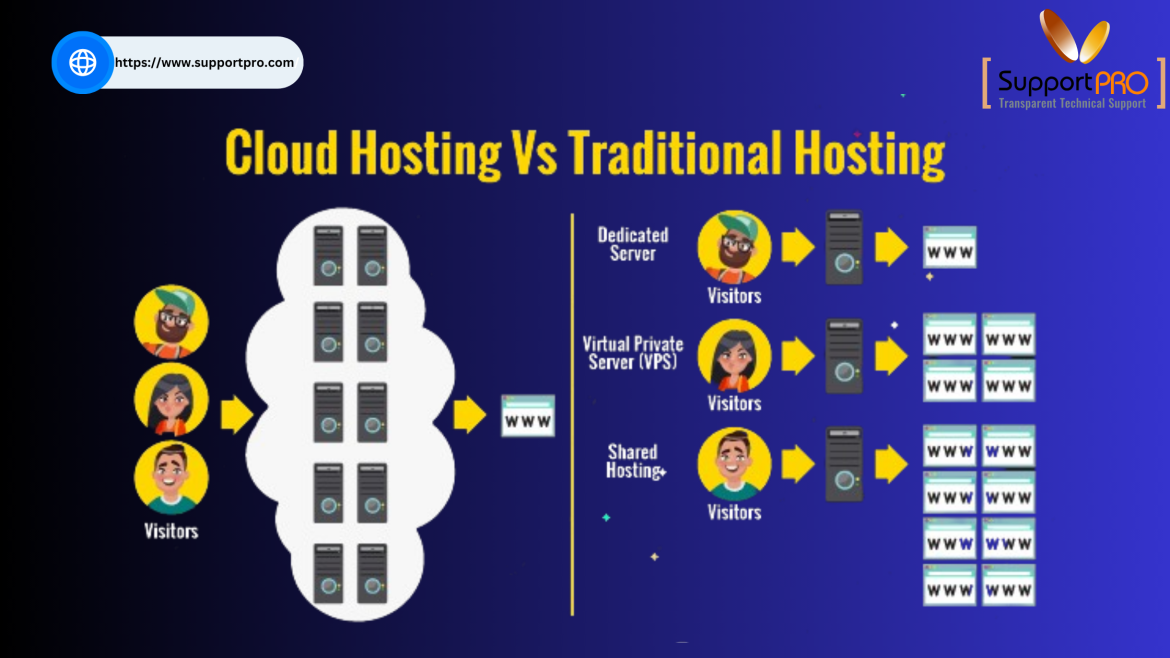
Choosing the right hosting solution is crucial for the success of any online business. With multiple options available, two of the most popular ones are cloud hosting and traditional hosting. Each has unique benefits, making the decision dependent on your business needs, budget, and goals. In this blog, we’ll compare cloud and traditional hosting to help you choose the right option for your business. What is Traditional Hosting? Traditional hosting refers to hosting solutions where your website or application is hosted on a single physical server. This can be further divided into three categories: 1. Shared Hosting In shared hosting, multiple websites share the same server resources. This is the most cost-effective option but can lead to performance issues when …