


For a hosting operations manager, a vulnerable integration service raises practical questions: Which customers depend on it? Can an attacker reach it? How can the team apply fixes without disrupting essential workflows? Apache Camel connects applications with databases, messaging platforms, cloud services, payment gateways, and third-party APIs. When those connections support customer-facing services, security weaknesses can become operational problems. Recent Apache Camel security vulnerabilities affect message deserialization, authentication, outbound callbacks, and Kubernetes integration management. Apache published the Camel component advisories discussed here in October 2026; the two Camel K advisories date to September 2026. Exploitation depends on the component, configuration, access, and permissions involved.
For hosting teams, the priority is to identify affected workloads, assign remediation responsibility, and verify that security fixes preserve the services customers rely on.
Which Apache Camel Vulnerabilities Should Hosting Teams Review?
Apache rates two of these flaws Critical and four High. Real-world risk still depends on which component a workload uses and how it is exposed.
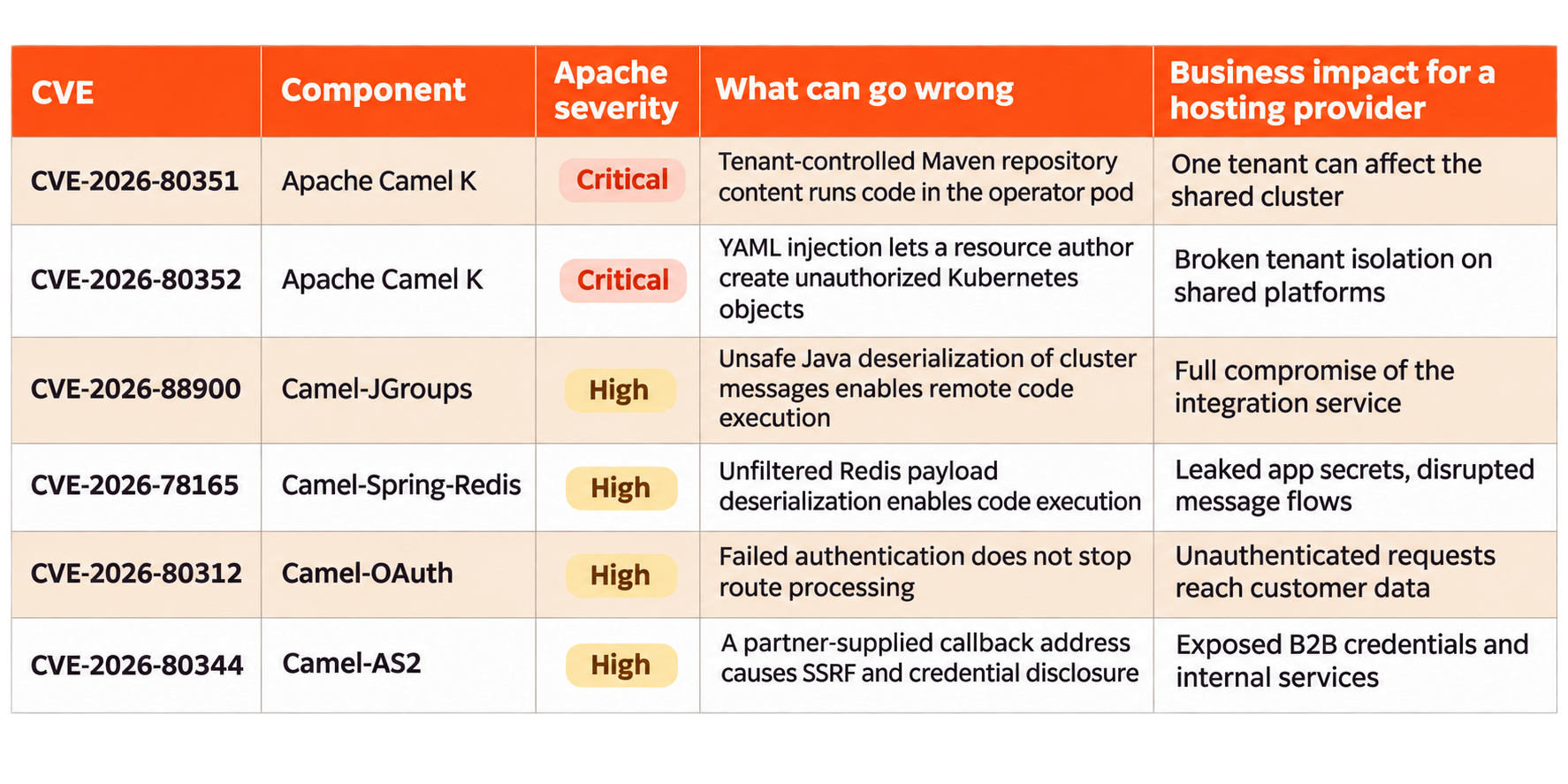
Check the official Apache Camel security advisories for affected releases, severity ratings and component-specific fixes.
How These Vulnerabilities Could Affect Hosting Services
Remote code execution through integration components
CVE-2026-88900 affects Camel-JGroups. Cluster messages can trigger unsafe Java object deserialization, so an attacker who reaches the communication path can run code inside the application process.
CVE-2026-78165 affects Camel-Spring-Redis. By default, Redis deserializes messages without an object input filter. An attacker who can publish to the subscribed channel can exploit this when the right conditions exist.
The damage rarely stays inside the integration service. Successful code execution can expose application secrets, halt message processing and give attackers a foothold for lateral movement across your hosting environment. Ops takeaway: lock down access to messaging infrastructure and stop treating internal traffic as trusted by default.
Authentication failures and exposed credentials
CVE-2026-80312 shows how Camel-OAuth mishandles failed authentication. Instead of stopping the exchange, the affected processors return control to the route, so a request that should fail keeps moving through the next processing steps.
CVE-2026-80344 targets Camel-AS2. A remote trading partner can supply an asynchronous message disposition notification (MDN) address that decides where the receipt goes. That opens the door to server-side request forgery (SSRF) and leaks any credentials sent with the request. We covered a similar credential-leak pattern in our post on SageMaker SDK credential exposure.
These flaws hit hardest where customers handle personal data, API tokens, or B2B transactions. Ops takeaway: authentication must fail closed, and every outbound destination needs validation before sensitive data leaves your network.
Risks inside Kubernetes and multi-tenant clusters
Apache Camel K runs inside Kubernetes, which raises the stakes for shared platforms. CVE-2026-80351 lets tenant-controlled Maven repository content trigger unsafe evaluation in the operator pod. CVE-2026-80352 allows YAML injection through the Master trait’s service-account setting.
Depending on your deployment and permissions, attackers can compromise the operator pod or create unauthorized Kubernetes resources. Ops takeaway: prioritize shared clusters and any platform that accepts workloads from multiple customers, because one tenant’s change can reach everyone else’s.
How to Check if your Apache Camel Deployment is Vulnerable
Start with an inventory: you cannot patch what you cannot see. Assign each step an owner and a deadline so the work fits your normal change process.
- Review dependencies. Scan Maven
pom.xmlfiles, dependency trees, build pipelines and container image manifests. Check each component’s version, not just the Camel core version. - Inspect running workloads. List every Camel application, Camel K installation, operator deployment and service that processes external messages or requests.
- Map exposure. Find out whether untrusted parties can reach Redis channels, JGroups paths, OAuth-protected routes or tenant-controlled Kubernetes resources.
- Compare versions. Match installed releases against the affected-version ranges in each Apache advisory.
Which Apache Camel versions fix these vulnerabilities?
Apache’s October 2026 security release sets these upgrade targets:
| Current release line | Upgrade to |
|---|---|
| Camel 4.22.x | 4.22.1 |
| Camel 4.18.x | 4.18.5 |
| Other Camel release lines | 4.23.0 or a supported LTS release |
| Camel K | 2.9.3, 2.10.2 or 2.11.0 |
The Camel 4.14.x LTS line has reached end of life and no longer receives these fixes. If customers still run it, plan a version migration rather than a patch.
Check each advisory against your current release before you pick an upgrade path, because later advisories may add requirements. The Apache Camel security release announcement has the full guidance.
Security Checks to Run Before and After Patching
Upgrading is your main fix, but application and infrastructure controls decide how much risk remains. Use this list as your change-window checklist.
- Messaging security: Restrict Redis and JGroups access, require authentication and apply deserialization filters.
- Route protection: Confirm that failed authentication stops processing and that sensitive endpoints enforce authorization.
- Secret management: Store credentials securely and validate callback URLs and outbound destinations.
- Kubernetes access: Review operator service accounts, RBAC permissions and who can create or edit custom resources.
- Change validation: Test critical integration flows in staging, back up configuration and prepare a rollback plan. Before any restart, collect the right logs so you keep your diagnostic trail.
- Post-update monitoring: Watch application logs, authentication failures, unexpected outbound connections and unusual Kubernetes resource changes.
If a vulnerable service faced untrusted traffic, patching alone may not be enough. Investigate suspicious activity and rotate any credentials that may be compromised. For a parallel example at the OS layer, see how we handled the Linux TCP vulnerability CVE-2026-98432.
Get Expert Help Patching Your Integration Environment
Patching integration software across many customer environments takes time your team may not have. SupportPRO’s DevOps support engineers audit deployed dependencies, coordinate application and infrastructure updates, and verify services after maintenance.
Need broader coverage? Our server administration and cloud management teams keep patching on schedule, and dedicated team support adds engineers who work as an extension of your team. If you suspect active exploitation, contact our emergency support team now.
Book a free server checkup to find out where your stack stands, or explore more posts in our server security section.
Frequently asked questions
Which Apache Camel vulnerabilities are the most urgent?
Apache rates the two Camel K flaws, CVE-2026-80351 and CVE-2026-80352, as Critical. Prioritize them on shared or multi-tenant Kubernetes clusters, then patch the High-rated JGroups, Redis, OAuth, and AS2 issues.
How do I check if Apache Camel is vulnerable in my environment?
Inventory dependencies and running workloads, map which components untrusted users can reach, and compare installed versions with the affected ranges in each Apache advisory.
Is Apache Camel 4.14 still supported?
No. The 4.14.x LTS line has reached end of life and no longer receives these fixes, so move those workloads to 4.18.5, 4.22.1, 4.23.0, or another supported LTS release.
Is upgrading enough to close the risk?
Upgrading closes the known flaws, but exposed services may already be compromised. Review logs, rotate credentials, and tighten access to messaging and Kubernetes resources.
Sources
Facing issues?
Our technical support
engineers can solve it.


