

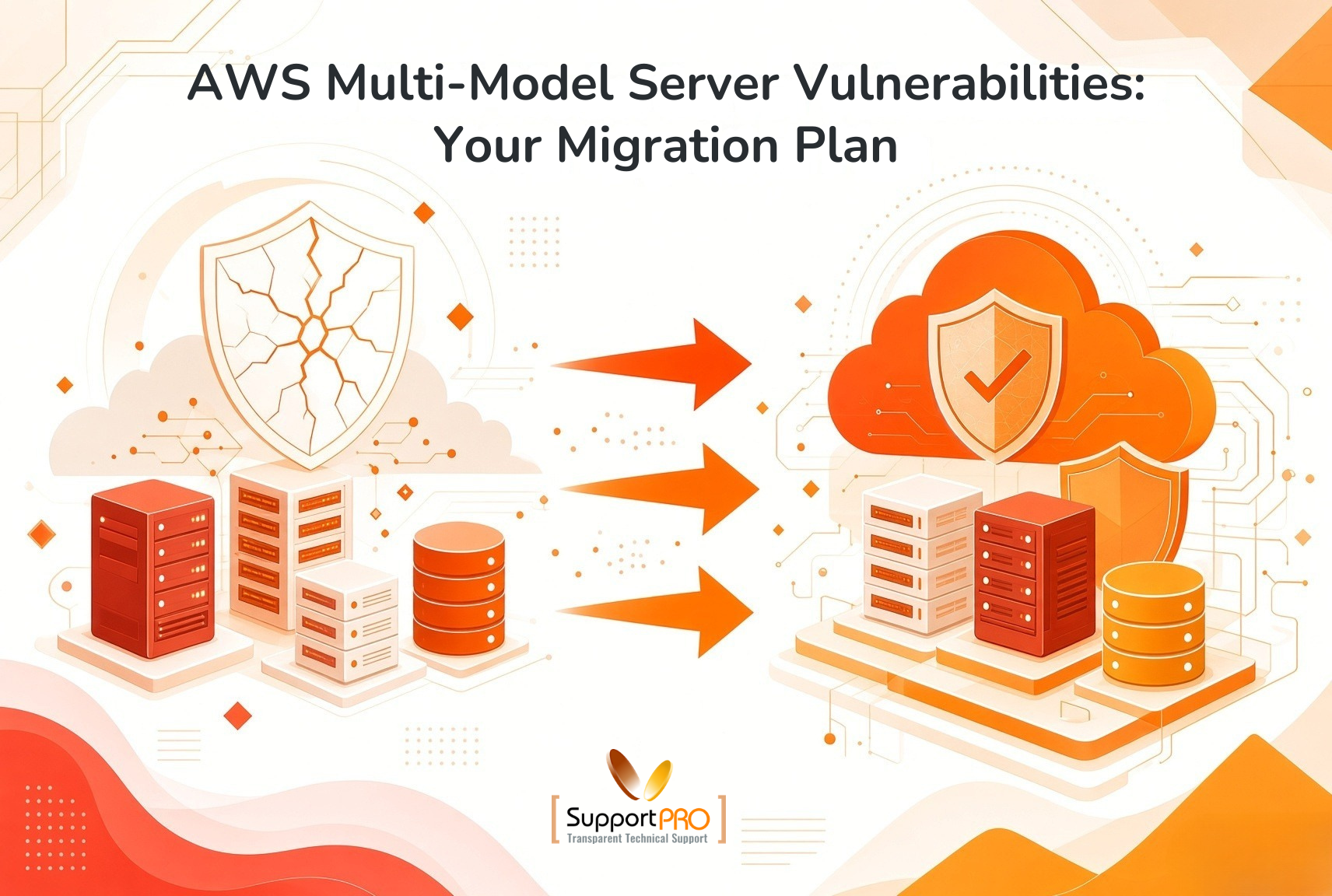
Imagine discovering a security vulnerability in a system that supports your customers’ applications, only to learn that no security patch is coming. For web hosting providers and cloud management teams, this creates more than a technical problem. It raises concerns about service availability, customer data, operational costs, and business reputation. On October 23, 2026, AWS disclosed two vulnerabilities in its open-source Multi Model Server (MMS): CVE-2026-115812 and CVE-2026-115813.
Both affect every released MMS version, including 1.1.11. More importantly, AWS has ended support for MMS and will not release security fixes.
If your hosting infrastructure or a customer’s application still relies on MMS, assess its exposure and plan a migration to a supported solution.
What Is AWS Multi Model Server, and Why Does It Matter?
AWS Multi Model Server is an open-source tool that helps organizations deploy and serve machine learning models through a single service. Businesses can use these models to support product recommendations, fraud detection, and customer behavior analysis.
For cloud service providers, managed hosting companies, and MSPs, the concern is whether MMS still runs inside customer environments or legacy workloads. You might manage hundreds of servers and containers, but do you know whether one of those older deployments still uses MMS? An outdated model-serving component can create security risks even when the rest of the infrastructure appears healthy.
What Are CVE-2026-115812 and CVE-2026-115813?
AWS identified two vulnerabilities affecting how MMS handles model files and downloads.
CVE-2026-115812: Model Archive Extraction
This vulnerability allows a specially crafted model archive to write files outside its intended directory. An attacker could potentially overwrite important files or execute malicious code using the permissions assigned to the MMS process. For hosting providers, a successful attack could compromise an affected customer’s model-serving environment and potentially disrupt dependent applications.
CVE-2026-115813: Model Download Vulnerability
This vulnerability can make MMS send requests to unintended network destinations. An attacker could potentially use this behavior to reach internal services that are not normally accessible from outside the hosting environment. The risk level depends on network access and how the server is configured.
Both vulnerabilities become especially concerning because the MMS management interface does not require authentication. If untrusted systems can reach it, attackers may exploit these weaknesses.
Why Should Web Hosting and Cloud Providers Be Concerned?
A vulnerable MMS deployment does not automatically mean a server has been compromised. However, leaving an exposed, unsupported component running can create significant business risks.
- Service disruption and SLA pressure: If an affected workload becomes compromised or unavailable, customers may experience application failures. For hosting providers, prolonged disruption can lead to support escalations, SLA concerns, and customer dissatisfaction.
- Customer trust and reputation: Customers expect their hosting provider to maintain a secure infrastructure. An avoidable incident involving an outdated component can damage that confidence, particularly when the provider manages business-critical applications.
- Higher operational costs: Security investigations, emergency configuration changes, incident response, and unplanned migrations can consume engineering resources. These activities may also pull your team away from normal infrastructure maintenance and customer support.
- Hidden security exposure: Older containers, forgotten deployments, and legacy customer applications can remain outside regular maintenance workflows. If your team does not know MMS is running, it cannot properly assess the risk.
These are challenges cloud infrastructure teams already face. Our article on common cloud management challenges and how to overcome them explores related operational and security concerns.
What Should Hosting Providers and Cloud Teams Do Now?
Since AWS will not release another MMS security update, businesses should focus on reducing their immediate exposure and preparing for migration.
1. Identify Existing MMS Deployments
- Start by checking your servers, Docker images, container registries, and cloud environments for MMS installations.
- Include production, staging, and older customer deployments.
- All released MMS versions are affected, so simply checking whether a server runs version 1.1.11 is not enough.
2. Review Management Interface Access
- Check whether the MMS management interface is accessible from the public internet or other untrusted networks.
- Review firewall policies, AWS security groups, and model-loading permissions.
- Where the deployment uses separate management and inference ports, AWS recommends binding the management interface to the loopback address.
- This workaround does not work for every configuration. Some deployments use the same port for management and inference, so moving management access to loopback would interfere with model loading. In those cases, restrict access to trusted callers and prioritize migration.
3. Restrict Model Downloads and Network Access
- Do not allow untrusted URLs to control model downloads.
- Limit model-loading activities to approved workflows, and review the destinations MMS can reach through outbound network connections.
- Monitor your model-serving environment for unexpected activity.
- These restrictions can reduce the attack surface, but they do not permanently fix MMS.
4. Migrate to a Supported Solution
- AWS recommends discontinuing MMS and moving to a maintained model-serving platform.
- Before migration, evaluate your existing model compatibility, APIs, deployment configurations, authentication controls, and performance requirements.
- Test the replacement before moving production workloads to reduce the risk of customer-facing disruption.
- After migration, remove outdated MMS services, unused container images, and unnecessary management endpoints. Update deployment templates to prevent the old software from returning.
- For hosting businesses managing multiple cloud environments, professional cloud management support can help coordinate infrastructure assessments and migration activities.
How SupportPRO Helps Hosting Providers Manage Cloud Security Risks
For web hosting companies and MSPs, identifying vulnerable infrastructure is only part of the challenge. You also need to maintain customer services while making necessary changes. That gets harder when your internal team already handles server monitoring, support tickets, security maintenance, and infrastructure troubleshooting. We help hosting providers and businesses manage these operational responsibilities through our Cloud Support and DevOps services.
Our team can assist with infrastructure security reviews, cloud configuration assessments, management interface access checks, migration planning, deployment automation, and ongoing server administration.With 24/7 server management and monitoring support, hosting businesses can strengthen their operational processes while keeping their teams focused on customers and growth.
Final Thoughts
The AWS Multi Model Server vulnerabilities remind us that outdated software can become a serious infrastructure concern, especially when security patches are no longer available.
For hosting providers, the priority is straightforward: identify affected deployments, restrict unnecessary access, and plan a controlled migration before a vulnerability turns into a customer-facing incident.
The cost of reviewing your infrastructure today may be far smaller than responding to an avoidable security incident later.
Need help reviewing your cloud infrastructure or planning a migration?
Contact SupportPRO to discuss your cloud management and infrastructure support requirements.
Facing issues?
Our technical support
engineers can solve it.


